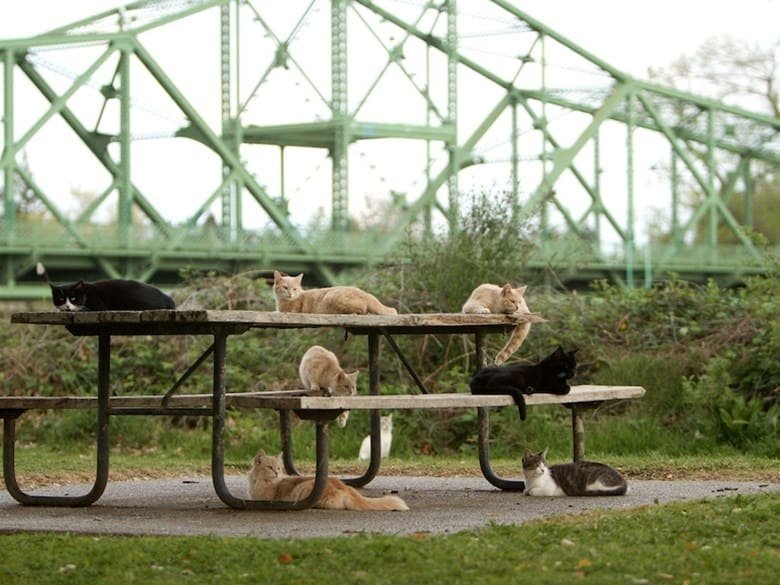
Feral cats have been a controversial topic of discussion with many groups for many years. In our region there are groups who take the time to trap, neuter, and release (TNR) feral cats and to feed feral cat colonies. The Sacramento-Shasta Chapter Conservation Affairs Committee became interested in this issue after hearing the Capital Public Radio Sacramento ‘River Cats’ Troubling To Wildlife, Human Health report in 2014. Prior to that the Committee knew that feral cat colonies existed in our region but we were unaware of just how many feral cats there are. The report estimated that there are as many as 1,000 stray cat colonies and it was estimated that there were 77,000 stray cats in Sacramento. We are interested in learning if the population has shrunk or grown since 2014.
The Wildlife Society has a position statement available on their website. The position statement includes the following language:
“Perhaps no issue has captured more of the challenges for contemporary wildlife management than free-ranging domestic cats and their negative effects on native wildlife (Loss et al. 2018; Loyd and DeVore 2010). Feral and free-ranging domestic cats (Felis catus) are among the IUCN’s 100 of the World’s Worst Invasive Alien Species (Lowe et al. 2004). Globally, domestic cats have contributed to the extinction of 63 species and are responsible for at least 14% of bird, mammal, and reptile extinctions on islands (Medina et al. 2011; Doherty et al. 2016). Invasive species present unique challenges for wildlife managers because the harm they cause to native species is often poorly understood by the public.”
The Sacramento-Shasta Chapter supports The Wildlife Society’s position statement and has the desire to:
- Add to the knowledge base of how many feral cats are in Sacramento County
- How much money and resources are needed and used to maintain feral cat colonies
- Find a time and way to survey for feral cat colonies
- Pursue education and outreach opportunities
- Brainstorm to find other methods besides TNR that can lead to a reduction in feral cat colonies.
The Conservation Affairs Committee is working on drafting their own position statement tailored to our area. Several years ago we attempted to convene a discussion group that is dedicated to reducing the feral cat population in Sacramento County. Although that effort was unsuccessful at the time, the Committee would like to revive the effort.
Contact Us
Mailing Address: 1017 L Street PMB 245, Sacramento, CA 95814
Email: sac.shasta@gmail.com